
It’s the second to last week of the season, and peak migration for Northern Saw-whet Owls is winding down accordingly. While we had a decent enough week with a good number of birds processed, our week’s total remains just barely below our best single night for the season from two weeks ago, a notable drop for a short time window.
This week saw continued warm weather, with the conditions being largely pleasant for the most part. I write this under sunny blue skies with the temperature hovering just over 60 degrees Fahrenheit. As a result we had many nights with south winds and fewer birds, although our two or three nights of good north to northwest winds brought in some colder temperatures and much more birds. Only one night had enough bad weather to keep some nets more exposed to the wind closed for most of the night. The Tamaracks on the point have not been fooled by the warmth, and now glow uniform yellow as this year’s needles fall.
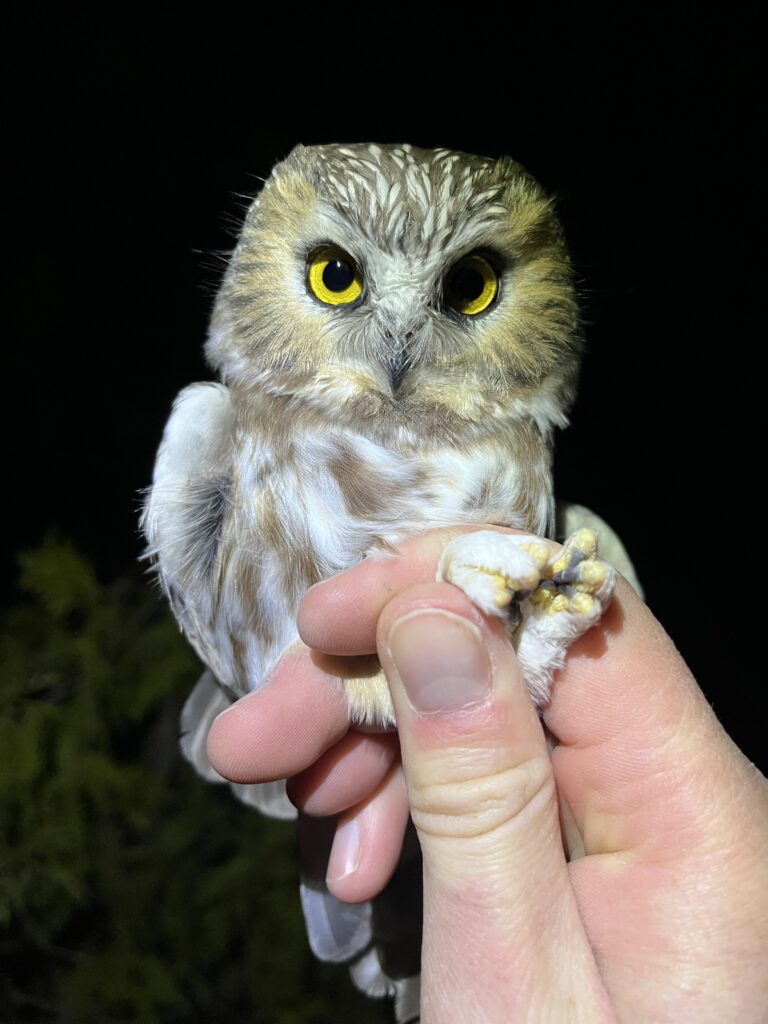
Among this week’s birds we had three recaptures, including two birds from our station on the point. Both were banded last fall, just two days apart (Oct. 16 and Oct. 14) and then recaptured by us also just two days apart (Oct. 27 and Oct. 29) although a bit later along in the season! The remaining bird was a TY unknown banded in 2024 as a HY male at Whitefish Point. Only a slight bit of weight gain can tip a male over into the unknown overlap zone that exists between the male and female size classes. As NSWOs are a sexually monomorphic species in which males and females are visually identical (at least to the human eye, the birds themselves seem to figure it out just fine) sizing criteria determined from genetic sexing studies provide the only way to ascertain the gender of the bird. As with most raptors, female NSWOs are larger than males, with a gray area of overlap zone in the middle, at least for now.
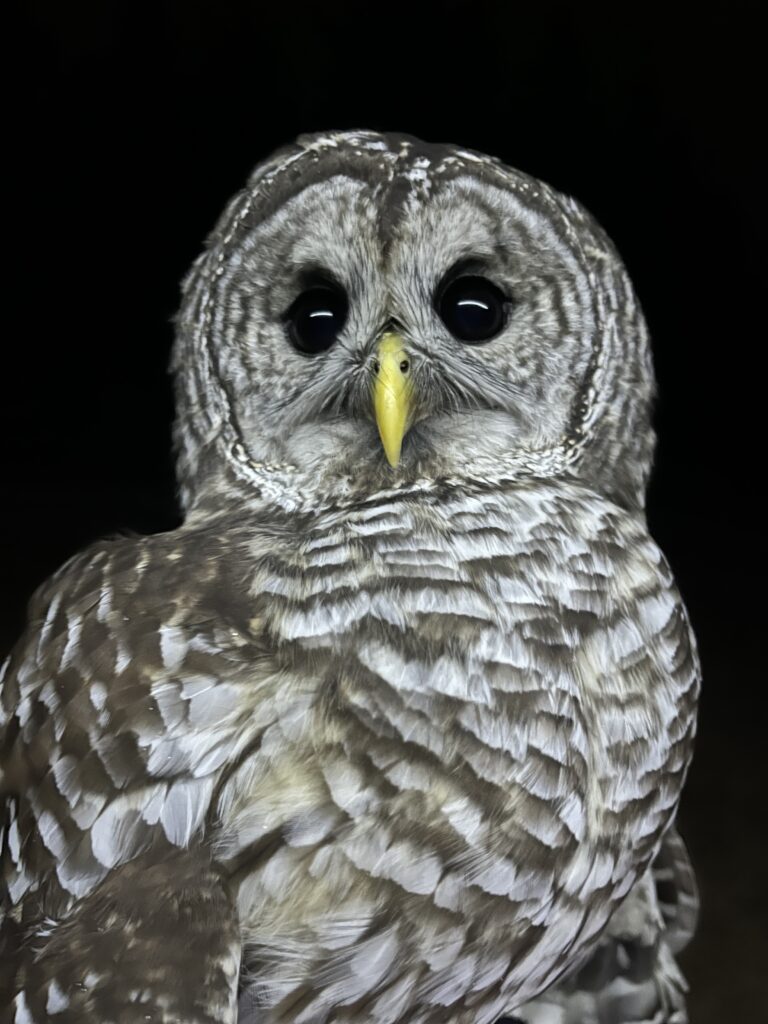
This week also saw the long anticipated capture of an additional owl species, setting the week off to a strong start. On the last check of the night before the closing net run, a dawn hunting Barred Owl was found in the lower reaches of the net at the triangle set up. As is often with Barreds it was a HY bird, younger and more keen on exploring new things than the presumably older more local birds who have largely ignored our set up for more lucrative frog hunting along the roadside wetlands. The bird clocked in at 742 grams or around eight times the weight of a normal female saw-whet. It was promptly banded and released, and hasn’t been hanging around the area since.
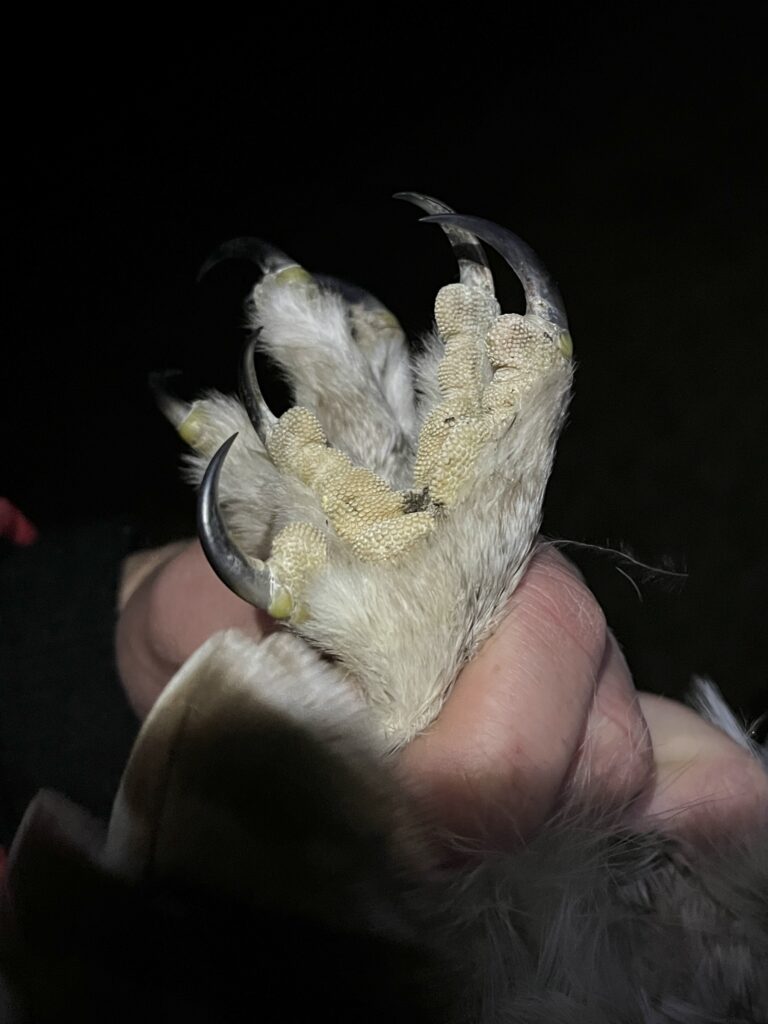
While not caught in the nets, a Great Horned Owl was seen in the area during a net check. The biggest owl in North America by weight (although not by length) these birds are relativity uncommon around Point LaBarbe and only seen infrequently in the area. This bird was perched up hunting over the marsh around dawn as I set out to check the nets for the last net run of the night.
Otherwise the flow of owls through the straits continues, moving from their breeding and natal grounds as the nip of winter lingers in the air, pushed along on northern winds as they drift south, east, and west to parts unknown for the fall and winter months. The last week of the season closes fast upon us, and the final push to briefly intercept them along this journey is just beginning.
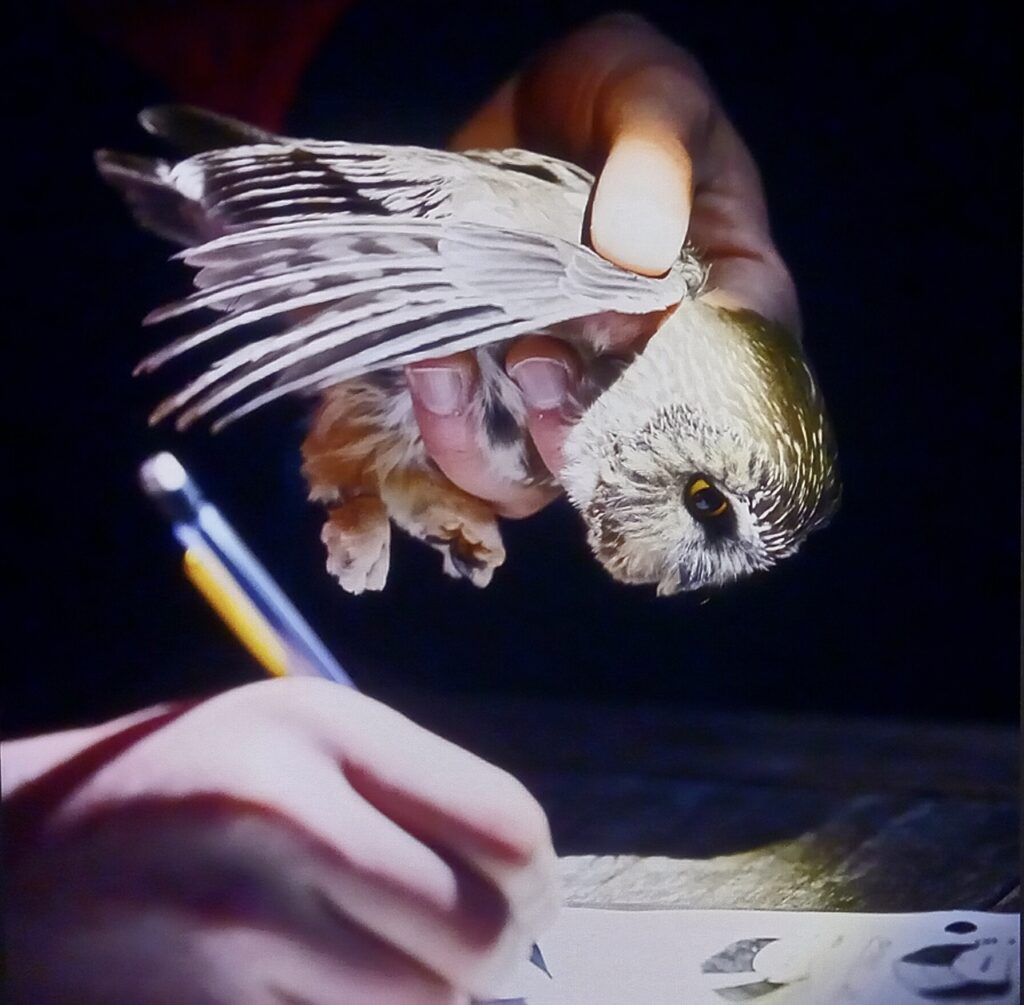
Key to age codes typically used in NSWO banding:
Hatch Year: HY – A fully grown bird in the same calendar year as it fledged the nest.
Second Year: SY – A bird in its second calendar year of life. All HY birds magically become SY birds on January 1st, even if they are only 6-8 months old.
After Second Year: ASY – A bird at least a year older than a SY, and in it its third or greater calendar year of life. For NSWO they will remain this age code until death, as beyond this age molt patterns in NSWO make exact aging undependable for most birds.
Third Year: TY – A bird known to be in its third calendar year of life, exactly one year older than an SY. TY birds can vary extensively in molt pattern and are typically aged as ASY. However, in a few individuals a clear TY pattern can be safely seen and used to age as TY. This code is relatively rarely used.
After Hatch Year: AHY – A fully grown bird with a molt pattern that clearly indicates it is not a HY bird, but with one that is too weird and irregular to safely classify as either SY or ASY. This code is also relatively rare.
Species totals to date: NSWO 254, BAOW 1, SSHA 1, AMWO 2, AMRO 2, WTSP 1, HETH 1