While not quite as dramatic as last week, this second week of peak season still saw a good pushes of birds most nights with suitable weather. The relativity warm temperatures of the season have continued this week, with a slight warm front riding in on southern winds, and making for variable conditions, even within a single night. The week started off strong with another 20+ bird flight, but that was to be our last at that level for the week. We had two nights with good northwest winds and excellent bird movement, and then a steady to a slow trickle of birds throughout every other night of the week, even getting a few birds on southern winds. The second full moon of the season is also now glowing down on us, leading to certain nets in more open areas being rather well lit, and likely more visible to owls who subsequently avoided them.
Overall this week saw around 22 percent of the season’s total, a decent bit over the purely numerically expected result for week six of 16 percent.
Recaptures this week remained interesting, with our second bird from each of the two locations that originally banded our captures. Both were older ASY birds banded as ASYs making exact ages unknown. The first came from MSRW spring owl banding on the other side of the straits, and was first banded in April of last year, making it at least four now.
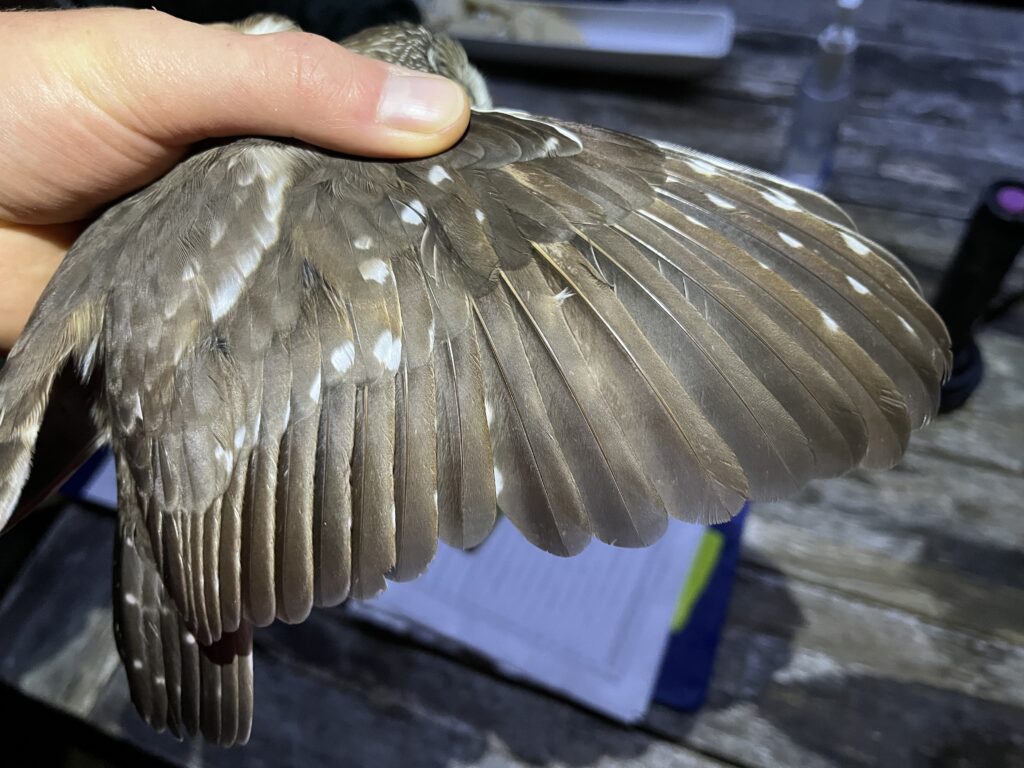
The second bird wore a faded 4-long band, and a quick glance revealed the complex fragmented scattered (although not definitively diagnostic) molt pattern I’ve come to associate with very old birds that have undergone many molts. Sure enough the banding lab results confirmed this was another 6+ year old bird making it tied for our oldest this season. Banded even further afield than the last older bird, this one was also an ASY in 2023, and at some point in the past three years has made the jump from Duluth, Minnesota to our station.
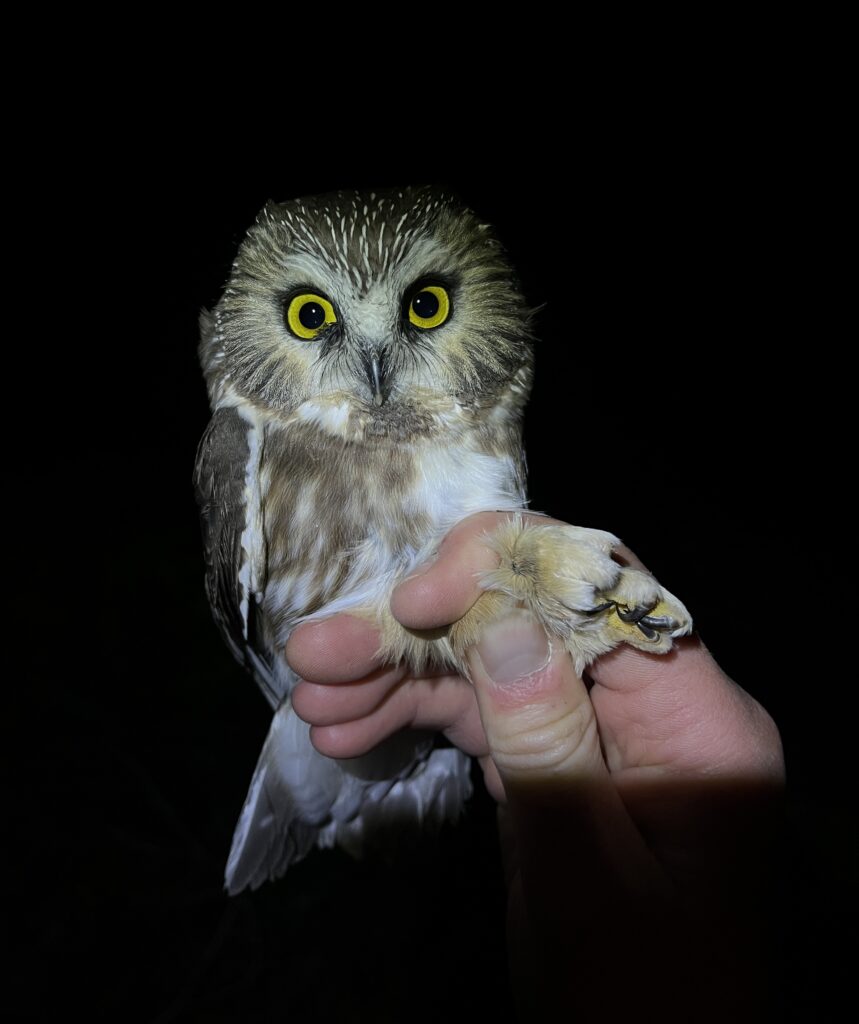
In addition to birds we have caught from other locations, another location has for this first time so far this fall, caught and reported one of our birds! While not a same year recapture of one of the birds we personally banded, this bird was banded here at Point LaBarbe in the fall of 2024, and was caught on October 17 in Nogies Creek, Ontario, roughly 300 miles to the southeast.
Long-eared Owl migration window is picking up, and while unlikely remains an increasing possibility in our nets. We came a step closer this week, with an excellent view of one perched low along the roadside in headlights moving between net checks. A quick caller switch to LEOW at one net lane for a few hours yielded no results however. While not very surprising, we did find this rather rude.
Otherwise that concludes week six. Conditions seem promising for at least a few nights next week, and we hope the push of birds continues. Stay tuned!
Key to age codes typically used in NSWO banding:
Hatch Year: HY – A fully grown bird in the same calendar year as it fledged the nest.
Second Year: SY – A bird in its second calendar year of life. All HY birds magically become SY birds on January 1st, even if they are only 6-8 months old.
After Second Year: ASY – A bird at least a year older than a SY, and in it its third or greater calendar year of life. For NSWO they will remain this age code until death, as beyond this age molt patterns in NSWO make exact aging undependable for most birds.
Third Year: TY – A bird known to be in its third calendar year of life, exactly one year older than an SY. TY birds can vary extensively in molt pattern and are typically aged as ASY. However, in a few individuals a clear TY pattern can be safely seen and used to age as TY. This code is relatively rarely used.
After Hatch Year: AHY – A fully grown bird with a molt pattern that clearly indicates it is not a HY bird, but with one that is too weird and irregular to safely classify as either SY or ASY. This code is also relatively rare.
Species totals to date: NSWO 225, SSHA 1, AMWO 2, AMRO 2, WTSP 1, HETH 1