
This week marked a huge uptick in NSWO migration! Mid October to early November is the typical peak window for saw-whet migration across their range, and this week seems to mark the start of the big push this year for our station. We set and then broke multiple single night high captures for the year, sometimes by almost double. Every night we banded saw over 20 new owls processed, and several interesting recaptures. Our only exception was one night when thunderstorm rains arrived early in the evening and we closed up after only a few net checks and one bird caught. In addition we had a night of full rain when no banding took place, and a two nights of winds in the 25-35 mph range which also precluded any attempts at banding. Despite this rather unfortunate timing of bad weather, which likely set our season total back by a good 60-80 birds, we ended the week on a decent note with 74 new birds banded, representing 41% of our five week total caught just this week.
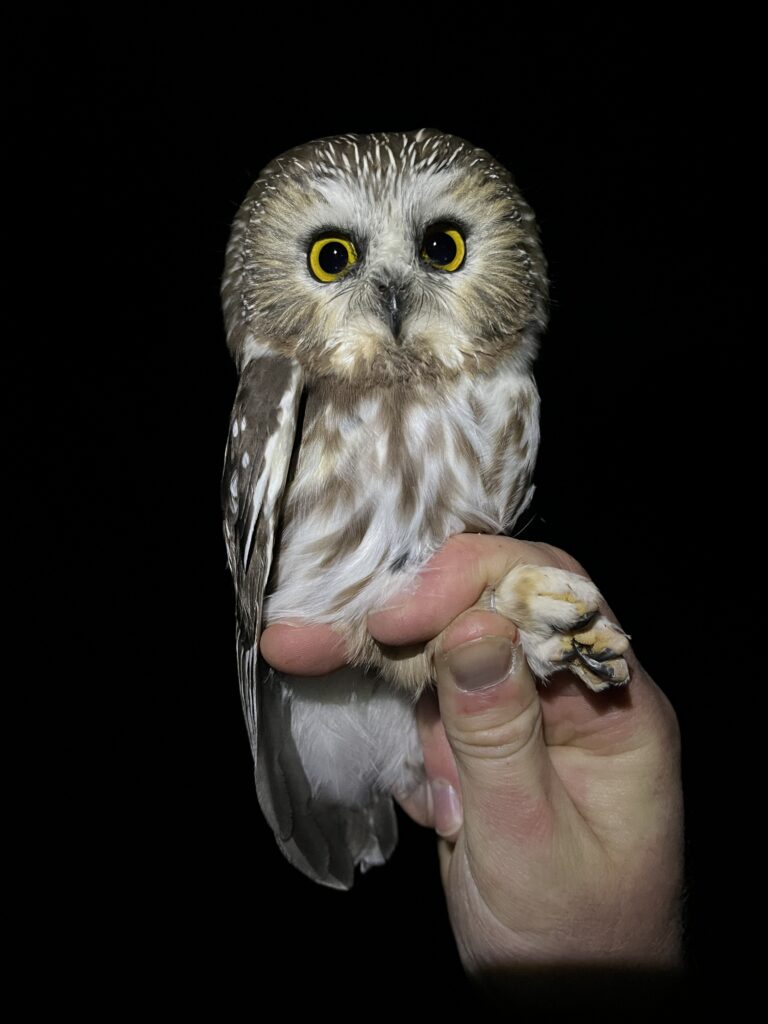
In addition to newly banded owls, we had a number of foreign recaps from other stations, including our furthest distance and oldest confirmed birds of the season thus far!
As might be expected, Whitefish Point is the most common location of origin for our recaptures, given it’s quite close proximately in terms of owl migration, and its location directly to our North. This held true this week with 3 of our 5 foreign birds that we have received data on from the banding lab originating there. Two were relatively uneventful, birds banded as HYs last year, or as a HY this summer. For an explanation of NSWO aging codes used in this post, see the key at the bottom of this page.
But one ASY with a faded gunk covered band immediately caught the eye as potentially interesting. As this is the oldest a NSWO can typically be safely aged, and includes a huge range of ages from 3 years old to the oldest a bird can get, it is exciting to catch a banded one that can be back dated to an exact age. And the data did not disappoint. This bird was banded at Whitefish in 2023 also as an ASY, meaning it is at minimum 6 years old! Given the fact that ASY is in effect 3+ years old, and that some small to medium percent of exactly 3 year old birds have an identifiable pattern and can be aged as TY, it’s fully possible this bird is even older than 6. With the oldest wild NSWO on record being 10 years old, this is a substantially old female, that has likely nested many times and is responsible for bringing 20 or more new saw-whets into the world. We processed her quickly and returned her to a branch from which she disappeared into the darkness.
We also caught a bird originally banded as a HY in Grand Forks, North Dakota in 2023 just over 600 miles away by straight line distance and the furthest point of origin for one of our birds this fall by over 200 miles. Our finally bird came from Manitoulin Island in Ontario, not far to our east, and was banded as a HY in 2025.
Otherwise things have been relatively uneventful at the station, with nights flip flopping dramatically between ideal conditions with north winds and peak bird movement to near gale force winds and pouring rain. Such is fall weather. While the temperatures are set to rise slightly again this week we also had our coldest night yet, with temperatures dropping to 27 degrees Fahrenheit and the dew freezing on the banding table. Perhaps brought in by that same cold front we saw our first true winter bird this week; a lovely light morph Rough-legged Hawk seen during the day at MSRW’s adjacent hawk watch site, and then circling over our banding area not long after. This bird marks the first (at least publicly documented) record of a returning Rough-legged Hawk in the state of Michigan for the fall of 2026.
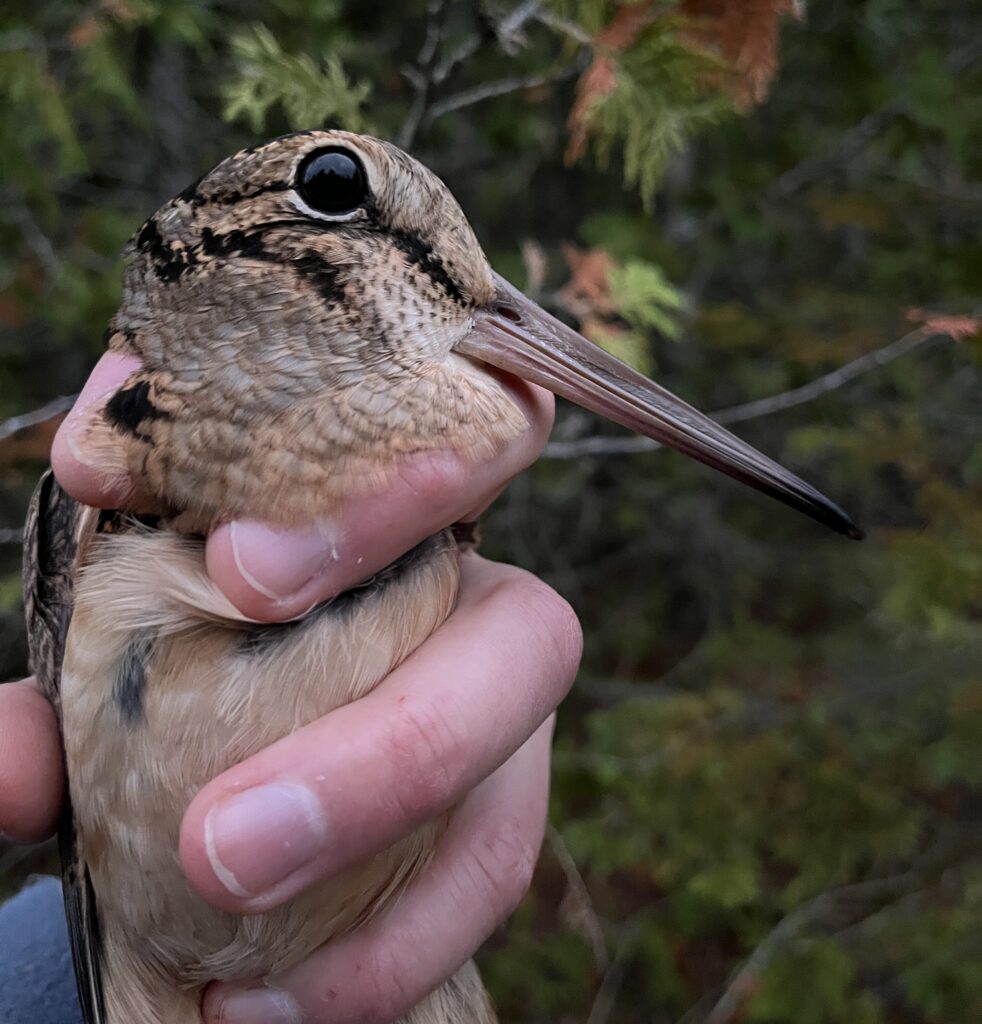
As we move later into the season our hopes for a non-NSWO owl capture climb. Late October and early November mark the peak of Long-eared Owls more limited movements through the area, and the coming weeks are our best shot at catching one. We did have one non-owl visitor to the nets this week, a fine American Woodcock. Our best single night record now stands at 35 birds, nicely up from last week’s 15.
Key to age codes typically used in NSWO banding:
Hatch Year: HY – A fully grown bird in the same calendar year as it fledged the nest.
Second Year: SY – A bird in its second calendar year of life. All HY birds magically become SY birds on January 1st, even if they are only 6-8 months old.
After Second Year: ASY – A bird at least a year older than a SY, and in it its third or greater calendar year of life. For NSWO they will remain this age code until death, as beyond this age molt patterns in NSWO make exact aging undependable for most birds.
Third Year: TY – A bird known to be in its third calendar year of life, exactly one year older than an SY. TY birds can vary extensively in molt pattern and are typically aged as ASY. However, in a few individuals a clear TY pattern can be safely seen and used to age as TY. This code is relatively rarely used.
After Hatch Year: AHY – A fully grown bird with a molt pattern that clearly indicates it is not a HY bird, but with one that is too weird and irregular to safely classify as either SY or ASY. This code is also relatively rare.
Species totals to date: NSWO 177, SSHA 1, AMWO 2, AMRO 2, WTSP 1, HETH 1