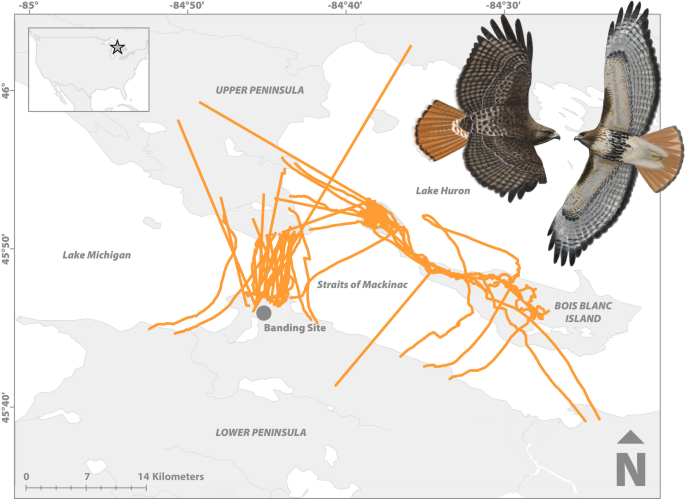
Alioto, N.A., Finley, A.O., Robinson, B.W. et al. Crossing the Straits of Mackinac: over-water uplift, wind support and low wind speed facilitates water crossings by a soaring migrant during pre-breeding spring migration. Mov Ecol 13, 68 (2025). https://doi.org/10.1186/s40462-025-00590-1
Excited to share the first chapter of my dissertation which is now published in the journal Movement Ecology – “Crossing the Straits of Mackinac: over-water uplift, wind support and low wind speed facilitates water crossings by a soaring migrant during pre-breeding spring migration”
This paper was a collaborative effort between the Mackinac Straits Raptor Watch, Michigan State University and the Cornell lab of Ornithology.

Nick A. Alioto, Andrew O. Finley, Bryce W. Robinson & Jennifer C. Owen
Author Affiliations –
Nick A. Alioto,1, 2 Andrew O. Finley,3 Bryce W. Robinson,4 Jennifer C. Owen,2
1Mackinac Straits Raptor Watch, Petoskey, MI, USA
2Department of Fisheries and Wildlife, Michigan State University, East Lansing, MI, USA
3Department of Forestry, Michigan State University, East Lansing, MI, USA
4Cornell Lab of Ornithology, Cornell University, Ithaca, NY, USA
Abstract
Background: Large bodies of water are ecological barriers known to influence the migration properties of avian migrants. Among soaring raptors, various flight strategies are used during migration to overcome these obstacles. These raptors exploit favourable winds and thermals to successfully migrate since prolonged flapping flight is expensive energetically. Soaring migrants circumvent large expanses of water and cross at geographical bottlenecks, minimizing the amount of open water they cross to save energy. Few studies have directly investigated how atmospheric conditions influence water crossing behavior during northbound pre-breeding spring migration at a high concentration bottleneck. However, inefficiently crossing ecological barriers during spring migration can lead to delayed breeding and fitness consequences for soaring raptors.
Methods: We use the Red-tailed Hawk (Buteo jamaicensis) as a model organism to investigate how atmospheric conditions influence the timing of water crossing at the Straits of Mackinac in Michigan, USA. We deployed 36 GPS transmitters during spring migrations spanning 2021–2023. Fifty-one water crossings from 33 adult individuals were used in this analysis. We annotated crossing events with atmospheric covariates including wind speed, wind support (V), crosswind (U), and uplift potential (temperature difference between water surface and air) to elucidate what conditions explain the probability of water crossing behavior by Red-tailed Hawks.
Results: We found that uplift over water was available in spring and that it positively affected the probability to cross. We also found that wind support and wind speed had a significant effect on crossing probability as low wind speeds and supportive wind increased the probability of crossing. The hawks had a higher probability to cross earlier in spring.
Conclusion: We provide evidence that uplift over water along with low overall wind speed and wind support facilitate water crossing behavior of Red-tailed hawks during pre-breeding spring migration. We also highlight that despite the general effects of uplift and wind there is substantial variation in crossing behavior among individuals. Our findings further contribute to the understanding of how soaring raptors overcome water barriers during migration.
Keywords: Buteo jamaicensis, Ecological barrier, Migration, Raptor, Red-tailed hawk, Soaring flight, Water crossing
You can download a PDF of the full open-access paper via this link: https://rdcu.be/eIXXH